
Electrical discharge machining
For 45 years, STEEC has been producing your most demanding parts in the Rhône region using electro-erosion machining. Complex shapes, hard materials, micron tolerances, for the aerospace, medical, defense and watchmaking industries.
Electrical discharge machining (EDM) is a high-precision process that allows for the cutting and shaping of very hard metals where conventional mechanical processes reach their limits. Specializing in wire EDM and micro EDM, STEEC supports major industrial clients in the manufacturing of technical parts, from blueprints, in small and medium production runs, as well as prototypes.
What is electrical discharge machining (EDM)?
Electrical discharge machining (EDM) is a material removal process that relies on a series of electrical discharges. A potential difference is established between an electrode and the workpiece, both immersed in a dielectric fluid. Each discharge removes a minute amount of material through localized melting and vaporization. By repeating this process thousands of times per second, the material is removed with exceptional precision.
The unique feature of this process lies in the absence of mechanical contact and cutting force between the tool and the workpiece. No pressure is exerted on the material, allowing the machining of thin, fragile, or highly complex parts without risk of deformation. The only requirement is that the workpiece must be electrically conductive, which covers the vast majority of technical metals and alloys.
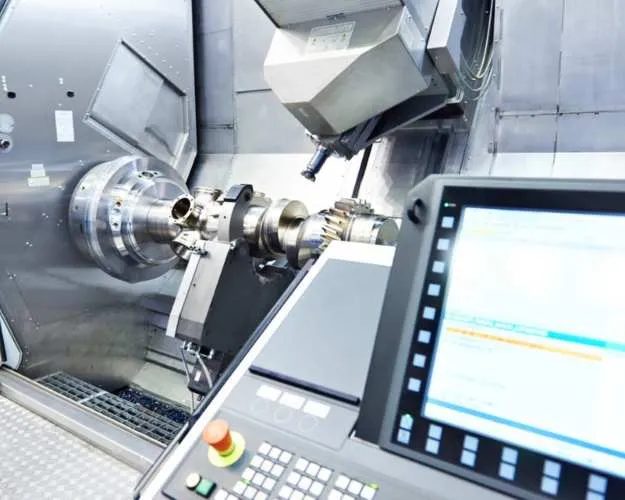
The two main families of electrical discharge machining
The term electrical discharge machining (EDM) actually encompasses two distinct processes, each addressing different needs. Understanding this distinction helps in choosing the right technology for your part.
Wire electrical discharge machining
A very thin metal wire, taut and continuously unwound, acts as an electrode. It passes through the workpiece and cuts it like a wire saw, following a path guided by numerical control. This is the preferred technology for through cuts, complex contours, and tight tolerances. It's STEEC's specialty.
Electrical discharge machining (EDM)
A machined electrode, either hollow or raised, often made of copper or graphite, is gradually inserted into the workpiece, reproducing its shape in negative. This technology is used for blind cavities, mold impressions, and internal shapes that wire cannot penetrate.
STEEC's positioning
STEEC focuses its expertise on wire electrical discharge machining (EDM) and micro wire EDM, two areas where precision and process control make all the difference. This specialization allows us to invest in dedicated machinery and achieve levels of finish that few workshops can offer on such fine geometries.
Cutting and machining by wire EDM in the Rhône (69)
Wire electrical discharge machining (EDM) allows for highly precise cutting of both thick parts and very thin strips. The wire, typically made of brass and with a diameter of approximately 0.25 mm, advances through a bath of demineralized water, which acts as a dielectric and removes the extracted material. The trajectory is entirely controlled by numerical control, ensuring perfect repeatability from one part to the next.
This process excels at shaping forms that traditional machining struggles to achieve, such as sharp internal angles, sinuous contours, tapers, or thin-walled parts. It is applicable to hardened steels, stainless steels, titanium, nickel-based superalloys such as Inconel, tungsten carbides, and many special alloys, including after heat treatment.
What wire electrical discharge machining makes possible
- Through cuts of complex shapes in 2D and 2.5D with tapers.
- Machining very hard materials, even when hardened, without degrading their properties.
- Very sharp internal angles, impossible to obtain with a milling tool.
- An excellent surface finish, without burrs and without mechanical repairs.
- A total absence of stress on the part, ideal for thin walls and fragile elements.
Cutting and machining by wire micro-electroerosion
Wire electrical discharge machining (EDM) pushes the process to the infinitely small. By using extremely small diameter wires, on the order of 0.02 to 0.03 mm, STEEC machines micro-parts and fine details that conventional methods cannot achieve. This technology meets the needs of micromechanics, connectors, watchmaking, and miniaturized medical devices.
At this scale, process control becomes crucial. The thermal stability of the workshop, the quality of the dielectric, the adjustment of electrical parameters, and dimensional control directly determine the final precision. It is this constant attention to detail that makes it possible to achieve tolerances of a few microns on tiny parts.
What materials can be machined by electro-erosion?
The only constraint of the process is the electrical conductivity of the material. As long as a metal or alloy conducts electricity, it can be machined by electrical discharge machining (EDM), regardless of its hardness. This characteristic makes EDM the ideal solution for materials considered difficult to machine.
| Materials family | Commonly machined examples |
|---|---|
| Steels | Hardened steels, tool steels, stainless steels |
| Superalloys | Inconel, Waspaloy, nickel and cobalt-based alloys |
| Refractory and hard metals | Tungsten carbide, molybdenum, tungsten |
| Light and non-ferrous alloys | Titanium, copper, brass, bronze |
Precision, tolerances and surface finish
Wire electrical discharge machining (EDM) is distinguished by its ability to maintain very tight tolerances, on the order of a few microns, on parts where the slightest deviation would compromise the final assembly. The absence of cutting force guarantees dimensional stability that mechanical processes cannot always achieve on fine geometries.
Each part undergoes rigorous dimensional control. This level of precision, combined with a controlled production environment, ensures the delivery of compliant parts from the very first batch and guarantees the reliability of your recurring production runs.
Advantages and limitations of electrical discharge machining
The advantages of the process
- Machining of the hardest materials, even hardened ones.
- Complex geometries and sharp internal angles.
- No mechanical stress on the part.
- Neat surface finish, without any burrs.
- Perfect repeatability in series.
Points of vigilance
- The material must be electrically conductive.
- The removal rate remains lower than that of conventional machining on simple parts.
- The process is mainly justified for high value-added technical parts.
This is why electro-erosion is rarely chosen by default, but becomes essential as soon as the hardness, complexity or fineness of the part exceeds the possibilities of traditional processes.
Parts for the most demanding sectors
The parts produced by electrical discharge machining (EDM) at STEEC are used in assemblies where reliability cannot be compromised. Our expertise is particularly suited to the aerospace, medical and dental, defense, watchmaking, connector, and more broadly, all precision micromechanical applications.
A modern fleet of machines, continuously being invested in
The quality of a part begins with the quality of the production tooling. STEEC regularly invests in a fleet of state-of-the-art wire EDM machines to guarantee precision, stability, and productivity. This continuous upgrade allows us to meet increasingly demanding technical challenges and deliver on the deadlines our customers expect.
45 years of experience in electrical discharge machining
Founded 45 years ago, STEEC has built a solid reputation in high-precision machining. This longevity is the result of a constant focus on quality, a relationship of trust with our clients, and the transmission of expertise within our teams. Every project benefits from this accumulated experience, from the feasibility study to the delivery of inspected parts.
Certified ISO 9001 and ISO 13485
STEEC is ISO 9001 certified for its quality management system and ISO 13485 certified for the manufacture of medical devices. These certifications attest to the rigor of our processes, the traceability of our production, and our ability to meet the strictest specifications, particularly in the medical field where documentation requirements are absolute.
Made in France by 100%, certified by the French Fab label
All our parts are machined in France, in our workshop in the Rhône region. This choice guarantees our customers proximity, responsiveness, and complete control over the production chain. The French Fab label illustrates our commitment to a French industry of excellence, capable of competing in the most technically demanding markets.
Cutting and machining by wire EDM in the Rhône (69)
We perform high-precision cutting with standard-sized wires, ranging in diameter from 0.15 mm to 0.25 mm, on all types of mechanical parts. All conductive ferrous and non-ferrous metals can be cut using this technology. We use brass wire, but for some of your projects, we can also cut with copper, molybdenum, or tungsten wire.
This wire electroerosion machining and cutting technology allows, depending on your needs, to achieve precisions of the order of ±2µm and an Ra which can go down to 0.2
Cutting and machining by wire micro-electroerosion
In addition to standard wire cutting, we pride ourselves on our ability to perform micro-cutting and micro-machining using fine wire electrical discharge machining (EDM). By using wires as small as 0.10 mm, 0.07 mm, or even 0.05 mm in diameter, we can meet your most specific requirements.
A recent machine park for your projects
To meet your expectations in terms of precision, deadlines, service and to respond to our desire to support you, we continually invest in our machine fleet.
Electroerosion can find applications in all sectors of industry and can be used in fields as specialized and varied as space, aeronautics, watchmaking, medical, nuclear and even automotive.
However, some of your projects are not compatible with this technology but don't worry, we will surely be able to respond to them in milling, drilling, flat laser cutting Or on tubes or even in sinking!
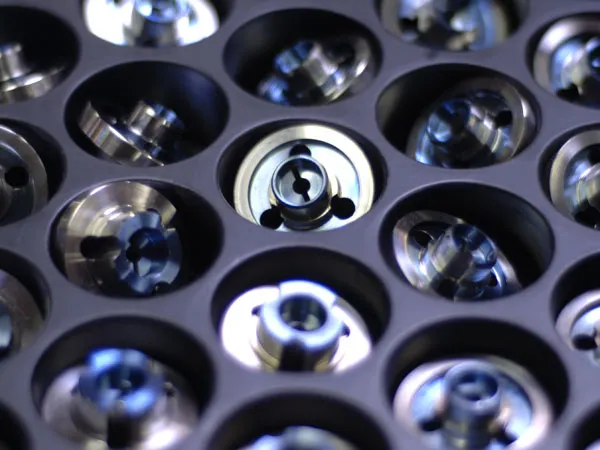

Frequently asked questions about electrical discharge machining
How does wire electrical discharge machining work?
Wire electrical discharge machining (EDM) uses a live wire to erode material through electrical discharges. The wire, usually made of brass, is guided along a path programmed by a CNC (Computer Numerical Control) system. The entire assembly is immersed in a dielectric fluid that removes the erosion residue. There is no mechanical contact between the tool and the workpiece. This makes the process unique for complex and delicate parts.
What materials can be machined by electro-erosion?
All conductive materials can be machined by electrical discharge machining (EDM). This includes steels, stainless steel, titanium, tungsten, molybdenum, nickel alloys, copper, and brass. EDM excels where conventional machine tools reach their limits: hard, hardened, brittle, or impossible-to-fix materials for grinding. The hardness of the material has no impact on the quality of the cut.
What level of precision can wire electrical discharge machining achieve?
At STEEC, standard wire electrical discharge machining (EDM) achieves accuracies on the order of ±2 µm. Surface roughness can be as low as Ra 0.2. These performance levels enable the production of tight-tolerance metal parts for precision mechanics. It is the benchmark process for complex parts that turning and milling or grinding cannot produce with this level of accuracy.
What is the difference between wire electrical discharge machining (EDM) and micro wire EDM?
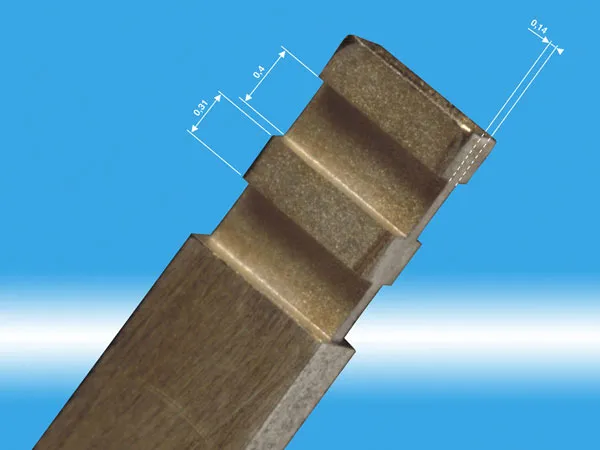
Standard wire electrical discharge machining (EDM) uses wires from 0.15 mm to 0.25 mm in diameter. Fine wire EDM goes down to 0.10 mm, 0.07 mm, or even 0.05 mm in diameter. This reduced diameter allows for the production of parts with extremely fine geometries, notches of a few hundredths of a millimeter, or internal radii impossible to produce otherwise.
STEEC is one of the few companies in France to master both levels on a dedicated fleet of machines.
Is electrical discharge machining (EDM) suitable for prototypes and small production runs?
Yes, that's one of its strengths. CNC programming allows you to move from a prototype to small, medium, or large production runs without changing tooling. The absence of tool wear guarantees perfect reproducibility between the first and last machined part. Manufacturing parts in a single batch or in several staggered deliveries is possible, depending on your subcontracting needs.
Does electrical discharge machining (EDM) replace conventional grinding or CNC machining?
It's not a replacement but a complement. Grinding handles large, flat surfaces at high speeds. CNC machining centers are better suited to three-dimensional parts with multiple axes of movement. Electrical discharge machining (EDM) is used where the geometry is too complex, the material too hard, or the tolerances too tight for these processes. For machining parts with closed internal shapes, sharp angles, or very fine grooves, it is often essential.
In which industrial sectors is wire electrical discharge machining (EDM) used?
Wire electrical discharge machining (EDM) is used in demanding sectors where precision is non-negotiable.
STEEC supplies machined parts for the aerospace (Airbus, MT Aerospace), medical (implants, stents, B. Braun), nuclear (CEA, Mirion Technologies), automotive (Valeo) and research (CNRS) industries. Manufacturing parts for watchmaking, space, and precision tooling is also part of our regular work.
How does subcontracting in electrical discharge machining (EDM) work at STEEC?
You send us your plan or specifications, we study the feasibility and submit a quote to you.
Machining of parts is carried out in France, in our workshop in Brindas (Rhône 69), using modern and certified machinery. STEEC is ISO 9001 and ISO 13485 certified for metal parts intended for the medical sector.
Each batch of machined parts goes through our quality control before delivery, prototypes as well as large series.
Need electrical discharge machining (EDM)? Contact us
For more information regarding this technology or to discuss your project, do not hesitate to contact us.